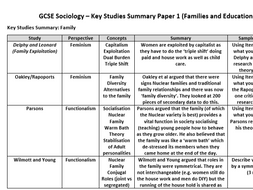
General Certificate of Education Advanced Subsidiary Examination January Sociology Unit 2 Tuesday 18 January For this paper you must have: an AQA page answer book. SCLY2 pm to pm Time allowed 2 hours Instructions Use black ink or black ball-point pen. Write the information required on the front of your answer book Jun 23, · January – Assess the strengths and limitations of using written questionnaires as a means of investigating prisoner’s experiences of imprisonment (15 marks) The theory focuses on the understanding and the r sociology a2 aqa sociology past papers SOCIOLOGY MASS MEDIA SCLY3 – Past Paper Questions. February 3, Sociology - AQA GCSE Mark Scheme January series 6 EITHER 0 7 Discuss how far sociologists would agree that women are less likely to commit crime than men. (12 marks) 0 No relevant points made. 1–3 Basic statements about crime and/or deviance and/or women. In this band, candidates spell, punctuate and use the rules
Sociology Past Paper - Term Paper
Labelling theory was devised by Becker who suggested that most people commit deviant or criminal acts but only some get caught and stigmatised for it. The theory focuses on the understanding and the reaction to and the definition of deviance itself. Becker claimed that deviance is in the eye of the beholder. There is nothing inherently deviant or criminal in any human act in all situations at all times, aqa sociology paper january 2011.
Something is only deviant if people are successful at being labelled as deviant or criminal. A clear example of this was explained by Becker through the use of a study by Malinowski who described the culture of a Pacific Island. A youth killed himself because he had been publically accessed of incest.
At first, the islanders expressed how disgusted they were and drove him to suicide. Someone had enforced that rule, often it was an ex-lover who was jealous. If the person was successful in making the label, consequences followed. It resulted in the youth being labelled and deviant and only left him with a few options like suicide.
Rules are made by moral entrepreneurs who lead moral crusades campaigns to change the law or to criminalise certain activities. Becker argues that this has invariably two effects. The creation of a new group of outsiders e. folk devils or the expansion of a social group like the police to enforce the law and label offenders.
There are problems with this approach, Akers criticised labelling theorists for presenting deviant people as perfectly normal people who are no different from anyone else until someone comes along and labels them. He argues that there must be some reason why the label has been applied to certain individuals and not others.
This is a criticism because it is suggesting people have no free will and can lead to some people becoming a self-fulfilling prophecy. Another criticism of labelling theory is that Marxists argued that not all laws are the product of moral entrepreneurs.
If they are, what are the conditions under which some groups succeed and others fail? This is a bad thing because it causes a class bias when the police enforces the rules. There are consequences to rule enforcing as explained by Lermert He said that primary deviance is the act which has not been publically labelled as deviant.
Secondary deviance is when the perpetrator is the consequences of the response of others to the crime. To demonstrate this, Lermert studied Inuit people who attached great importance in the ability to speak clearly. Primary deviance in this case was not being able to speak clearly when doing ceremonial speech making.
Those who have the labelled were often stigmatised. It often became their master status. The master status lead to a crisis of self-identity and the children became a self-fulfilling prophecy. Liazos criticises labelling theorists for simply exploring marginally deviant activities, as by doing so, they are reinforcing the ideas of prostitutes and mentally ill people as being deviant.
They do not challenge the status quo. Gouldner also criticises the labelling theorists for their failure to provide any real challenge to the status quo. He argues that studies criticise professionals. It draws attention away from real crimes. OR 4 Assess the view that the owners of mass media corporations control media output and serve mainly ruling-class interests.
AQA-SCLY3-W-MS-JAN12 — aqa sociology paper january 2011 scheme, aqa sociology paper january 2011. JUNE — Mass Media Answers SCLY3. EITHER: 3 Assess postmodernist contributions to our understanding of the role of the mass media in society today.
OR 4 Assess the view that the news is a social construction. AQA-SCLY3-W-MS-JUN12 — mark scheme. OR 4 Assess the view that the mass media are helping to create a single global popular culture. AQA-SCLY3-W-MS-JAN13 — mark scheme. EITHER: 3 Evaluate the contribution of Marxist theories to our understanding of the organisation and role of the mass media in the world today.
OR: 4 Evaluate the impact of the growth and increasing diversity of the new media on society today, aqa sociology paper january 2011. AQA-SCLY3-W-MS-JUN13 — mark scheme. EITHER: 3 Evaluate the effects of globalisation on the role of the media in society over the past 30 years or so. AQA-SCLY3-W-MS-JUN14 — mark scheme. EITHER: 3 Critically examine the relationship between ownership and control of the mass media.
AQA-SCLY3-W-MS-JUN15 — Mark scheme. JANUARY Item: Over the past few decades there has been considerable interest in the relationship between the mass media and gender. For example, feminists have criticised aqa sociology paper january 2011 production companies for showing women in stereotypical roles.
Other sociologists have identified the mass media as important agents in the social construction of gender differences. More recently, Cumberbatch found that, aqa sociology paper january 2011 women featuring strongly in television programmes such as soap operas, men now fill 65 per cent of all broadcast roles. There are even differences in news and current affairs on-street interviews, where women are asked for their opinion only a third as frequently as men. However, it is not simply the issue of representation that raises concerns.
Some aqa sociology paper january 2011 that women generally have less power and hold fewer key decision-making aqa sociology paper january 2011 in the media industries than men. Stereotypes generalise about groups as a whole and ignore the different characteristics of individual members. Sociological research on ethnicity, disability, gender, social class and age has revealed significant stereotyping by the media. For example, minority ethnic groups and young people are often represented as a source of social problems.
Portrayals of such groups are often simplistic and far from accurate. However, such labelling may bring in bigger audiences or aqa sociology paper january 2011 more newspapers, aqa sociology paper january 2011. However, it is not only issues of bias that concern sociologists studying the media.
Some also criticise the media for failing to tackle difficult issues and for continuing to put forward representations of certain groups that reinforce and perpetuate stereotypes. Such representations include those of women, certain minority ethnic groups, aqa sociology paper january 2011, age groups and those with disabilities.
For example, there is a range of research, including that by Cottle and Hargravewhich shows that black and Asian minority ethnic groups are often linked to violence or criminality in representations by the mass media. For example, news broadcasts form the key element of many TV channel schedules. Some sociologists argue that the news is an unbiased and factual account of events. In their view, the news is presented with authority and is a true record of what has taken place.
However, aqa sociology paper january 2011, other sociologists disagree with this view. They argue that the reporting of news is inevitably biased and that news presentation distorts reality. For example, some argue that young males are often stereotyped as delinquent or engaging in various forms of anti-social behaviour, aqa sociology paper january 2011. However, some sociologists argue that such stereotyping is less of a concern today. They argue that the media now present a balanced picture and provide a true representation of reality.
The growth of new media has produced a new range of issues and has challenged some of the traditional theories of the media. By continuing to use this website, you agree to their use. To find out more, including how to control cookies, see here: Cookie Policy.
GCSE SOCIOLOGY Exam Technique
, time: 56:34AQA A-Level Sociology Past Papers - Revision World
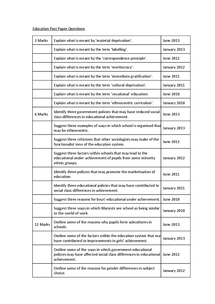
Sociology - AQA GCSE Mark Scheme January series 6 EITHER 0 7 Discuss how far sociologists would agree that women are less likely to commit crime than men. (12 marks) 0 No relevant points made. 1–3 Basic statements about crime and/or deviance and/or women. In this band, candidates spell, punctuate and use the rules Jun 23, · January – Assess the strengths and limitations of using written questionnaires as a means of investigating prisoner’s experiences of imprisonment (15 marks) The theory focuses on the understanding and the r sociology a2 aqa sociology past papers SOCIOLOGY MASS MEDIA SCLY3 – Past Paper Questions. February 3, Jun 23, · June Assess the relative importance of the different factors that affect sociologists’ choice of research methods and of topics to investigate. (33 marks) January Assess the view that positivist methods are inappropriate for investigating society. (33 marks) June ‘Sociology can be value-free and should be value-free.’ To what extent do

No comments:
Post a Comment